
Jacques, what does responsible commitment mean to you?
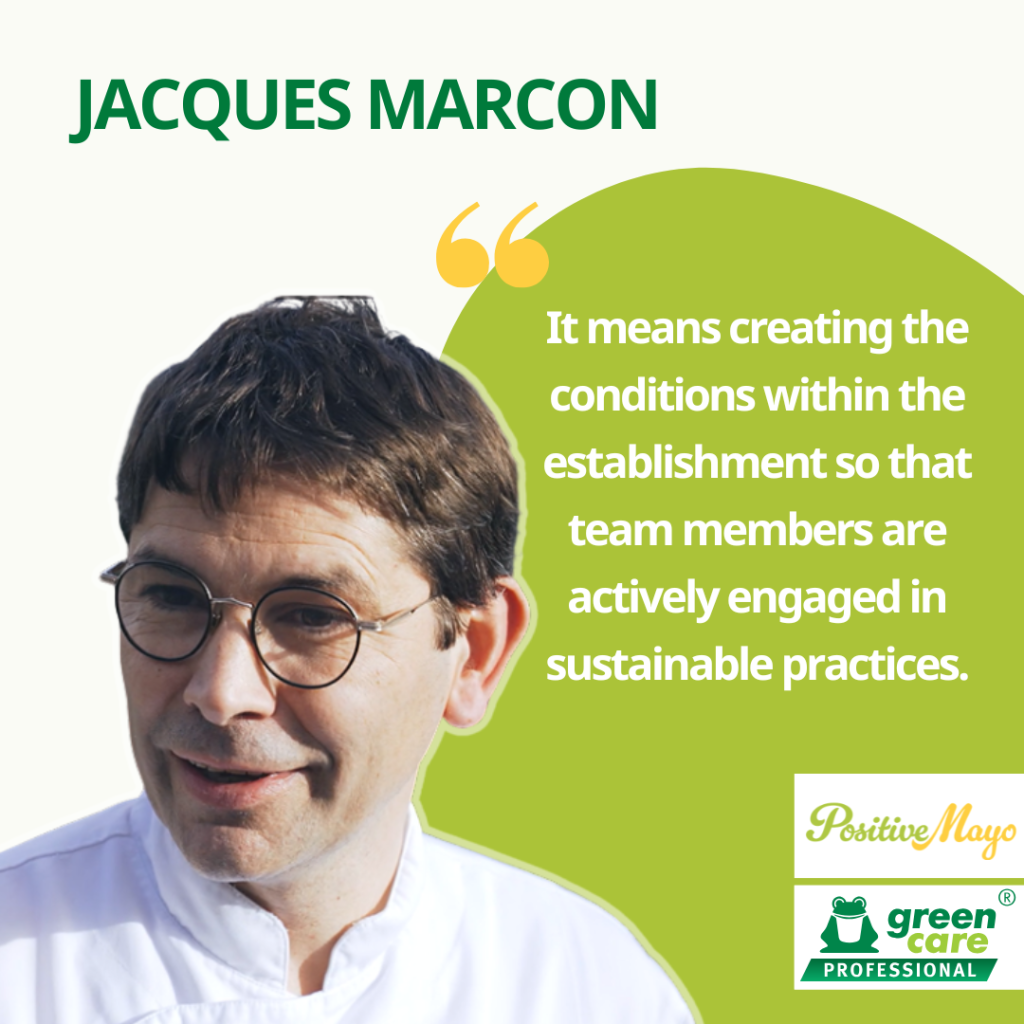
t means creating the conditions within the establishment so that team members are involved in sustainable practices — in terms of products, management, waste reduction, energy savings… — in order to train future chefs and entrepreneurs with these values.
In practical terms, what is your favorite eco-gesture or the most effective action you take on a daily basis?
Our main action is certainly selective waste sorting.
How do you integrate this approach into your operational practices (hygiene, team management, environment, etc.)?
It is an ongoing process of training. We have an eco-label in all our establishments, and it requires us to always do better and continuously improve. For example, we recently switched to biodegradable and compostable cling file.
Our teams are very motivated and committed to these issues. The new generation is much more open to these topics and applies practices with great rigor.
In your opinion, how can a sustainable approach enhance performance or create collective value?
I am not particularly focused on performance. What matters to me is collective value. Beyond cooking and technique, the question of sustainability is truly important.
What changes would you like to see emerge in your sector in terms of sustainability?
IChange is already underway. Waste sorting, short supply chains… all of this has become obvious. Now, we still have a lot to do when it comes to people. Managing people is an integral part of sustainability.
Of course, we must absolutely protect resources, and I attach great importance, for example, to issues such as overfishing.
But I also believe we must avoid extremism and not fall into communication-driven approaches. Serving coffee and using certain products that we do not have in France should remain possible — we need to stay pragmatic.
We must also avoid being overly moralizing…