

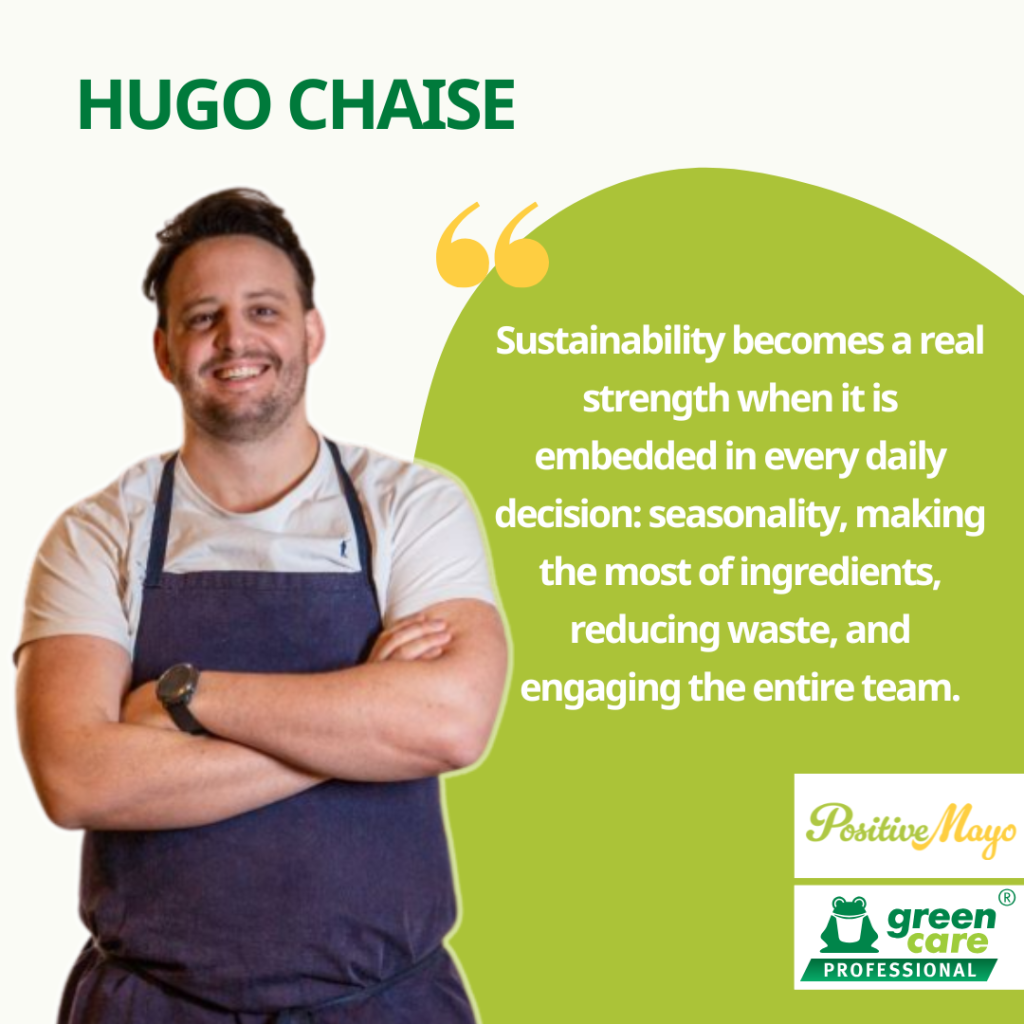
Hugo, what does responsible commitment mean to you?
It’s a very broad concept. For us, like for most chefs today, it mainly translates into seasonality. We work exclusively with seasonal produce—or even with micro-seasons. We don’t go beyond what’s available at any given moment.
By micro-season, I mean recognizing that certain products are only available for a very short period, so we make the most of them while they’re here. We always try to use ingredients at the peak of their production and availability.
It also extends to the way we use the consumables involved in our cooking. I’m not reinventing the wheel, of course, but we do everything we can to avoid plastic wrap and single-use items. Everything we use is stored in reusable containers.
For me, responsible commitment is very much about that. It’s about the products and the producers. We do everything we can to work with the right producers as well. Of course, being based in Paris, there are limits to what we can do.
The same goes for coffee: choosing the right roasters, working with people who share the same level of commitment that we do. That’s really what matters—working with partners who are on the same page. Obviously there are sometimes compromises. For example, my fruit and vegetable supplier isn’t always ideal, but we do the best we can with the tools we have and with what matches our customers’ expectations, even if we also try to guide them.
For example, we produce our own soft drinks, so we don’t serve Coca-Cola or similar products. We only offer organic French fruit juices and our own kombuchas.
In practical terms, what is your favorite eco-friendly habit or the most effective action you take on a daily basis?
We really run a kitchen where nothing is wasted—we throw absolutely nothing away. And I think that’s what gives me the greatest satisfaction.
Our menu is extremely flexible, and anything that’s no longer needed for the menu is eaten by the team, because we obviously need to eat too.
We genuinely operate a zero-waste kitchen. That’s probably the thing I’m most proud of.
I may have thrown away two hundred grams of carrots once…
The truth is that we’re working on all fronts. We’ve also reduced the water flow from our taps. Overall, we’re constantly trying to implement the very best practices available.
How do you integrate this approach into your operational practices (hygiene, team management, environment, etc.)?
It has mainly involved adapting the way we rotate our menu. That’s where it really happens for us.
I used to be very rigid about changing the menu every three weeks, always on a Tuesday. But I’ve learned to relax about that. If it’s three weeks and two days, or three weeks and three days, or even a fourth week because we still have products left that haven’t been sold, that’s fine.
I’ve learned to be more flexible and to stop being so rigid about certain principles.
As for team management, it’s really about training. I don’t have a large team, so it’s easier.
Max, my head chef, is already very aware of these issues and genuinely interested in them. I involve him in everything we do. We taste everything together, so that also becomes a form of awareness and education.
Since I’m the final decision-maker in the business, I place a lot of emphasis on the coffee we choose, why we choose it, and who we choose to work with.
Beyond that, Max works almost entirely independently.
Ultimately, it’s about the values we’re trying to pass on.
I’ve had several interns over the years, and it’s important to take the time to explain why we do things this way, how we do them, and who we’re doing them for.
There’s a lot of explaining involved—almost a form of evangelizing, although I don’t particularly like that word.
It’s really about discussion and communication. I think that’s incredibly important.
Even more than the actions themselves, it’s about constantly communicating, exchanging ideas, and repeating the message—to the team and to our customers.
When customers ask, “Why don’t you have avocados?”, we explain why.
We explain to the team why we’re doing certain things, why we’re using strawberries at one time of year rather than another.
And when we create new menus, I involve everyone who’s present.
It encourages everyone to think about what’s currently in season. Seasons have shifted somewhat, so yes, strawberries arrived a little earlier this year. Cherries are abundant, so when should we use them? And so on.
In your opinion, how can a sustainable approach enhance performance or create collective value?
If we’re talking about performance in the strict sense, sustainability is inseparable from seasonality.
That means you’re always working with the very best products at the very best time.
As Joël Robuchon used to say, “You can’t make great cuisine without great ingredients.”
His cooking reflected that philosophy perfectly.
We’re therefore able to offer the best ingredients at the peak of their season, which allows our customers to truly enjoy our vegetarian cuisine without asking themselves too many questions.
So for your business, it's beneficial in that sense.
Absolutely.
It’s extremely beneficial because it builds customer loyalty—not only through the quality of the food and the quality of the service, but also through the quality of our approach.
Today, both we and our customers are looking for a meaningful approach.
Many of our customers come back precisely because they appreciate what we’re doing.
And in terms of collective value, I genuinely believe we all have to move in that direction.
Serving tomatoes or red berries in the middle of winter—that simply doesn’t make sense to me.
Finally, what changes would you like to see in your sector when it comes to sustainability?
Personally, I think the legal obligation to recycle organic and plant-based waste is a good thing.
But I’d like to see much more support from local authorities.
Right now, everything is pushed back onto us, whereas I’d like to see real assistance and a proper collection system put in place by public authorities.
Just as we have glass recycling containers or cardboard collection points, there should be dedicated collection points for organic waste everywhere, accessible to everyone—including small businesses like mine.
There’s an organic waste collection bin in my street, but I have to transport everything there myself.
It’s not very far, but if I’m not there one day, what happens?
Everything just ends up in the same bin.
And our premises are tiny—we simply can’t have eighteen different bins.
That’s really my main concern.
I feel we’re being asked to carry an enormous burden.
If society expects us to become more sustainable and imposes legal sustainability requirements, then everyone needs to play their part.
It should be a genuine partnership.
We’re already doing an enormous amount: managing our energy consumption, reducing product waste, working with seasonal ingredients, choosing environmentally friendly cleaning products, thinking carefully about materials whenever we renovate the restaurant…
Today, most new projects are already designed with sustainability in mind.
And yet we’re still expected to manage everything ourselves.
On top of that, it’s now a legal obligation, and if we don’t comply perfectly, we’ll be criticized and penalized.
If we’re going to talk about sustainability, then let’s do it together and create a system that genuinely enables everyone to make it work—with collection points and infrastructure available everywhere.