

Christian, hat does responsible commitment mean to you?
Well, it’s about being committed every single day—every single hour, even. Young people today are much more aware of these issues, but we still have to keep reminding them to do the right thing: to sort waste properly, to do it thoroughly so that it can then be turned into compost.
Here, we’re a company that is truly committed. Last year alone, we recycled 44 tonnes of organic waste, which we were able to return to nature in a way, giving back a little of what nature gives us. This is a large operation—we have three restaurants on the same site. So yes, I would say it’s really about having the discipline to do the right things every day.
In practical terms, what is your favorite eco-friendly habit or the most effective action you take on a daily basis?
Yes… what else could I mention? We could talk about the complete conversion of the restaurant to LED lighting, as well as motion sensors installed in the areas that are used less frequently to avoid unnecessary energy consumption.
The truth is that we’re working on all fronts. We’ve also reduced the water flow from our taps. Overall, we’re constantly trying to implement the very best practices available.
How do you integrate this approach into your operational practices (hygiene, team management, environment, etc.)?
It also applies to the way we use our products. We’ve introduced a number of measures to prevent waste. We work with eco-labelled products, but even those still have an environmental impact. So we focus on proper dilution, and we monitor product consumption every day.
If you don’t keep an eye on it, people tend to think that using more product will make the job better. But that’s not the case—you just need to put in a bit more elbow grease.
In your opinion, how can a sustainable approach enhance performance or create collective value?
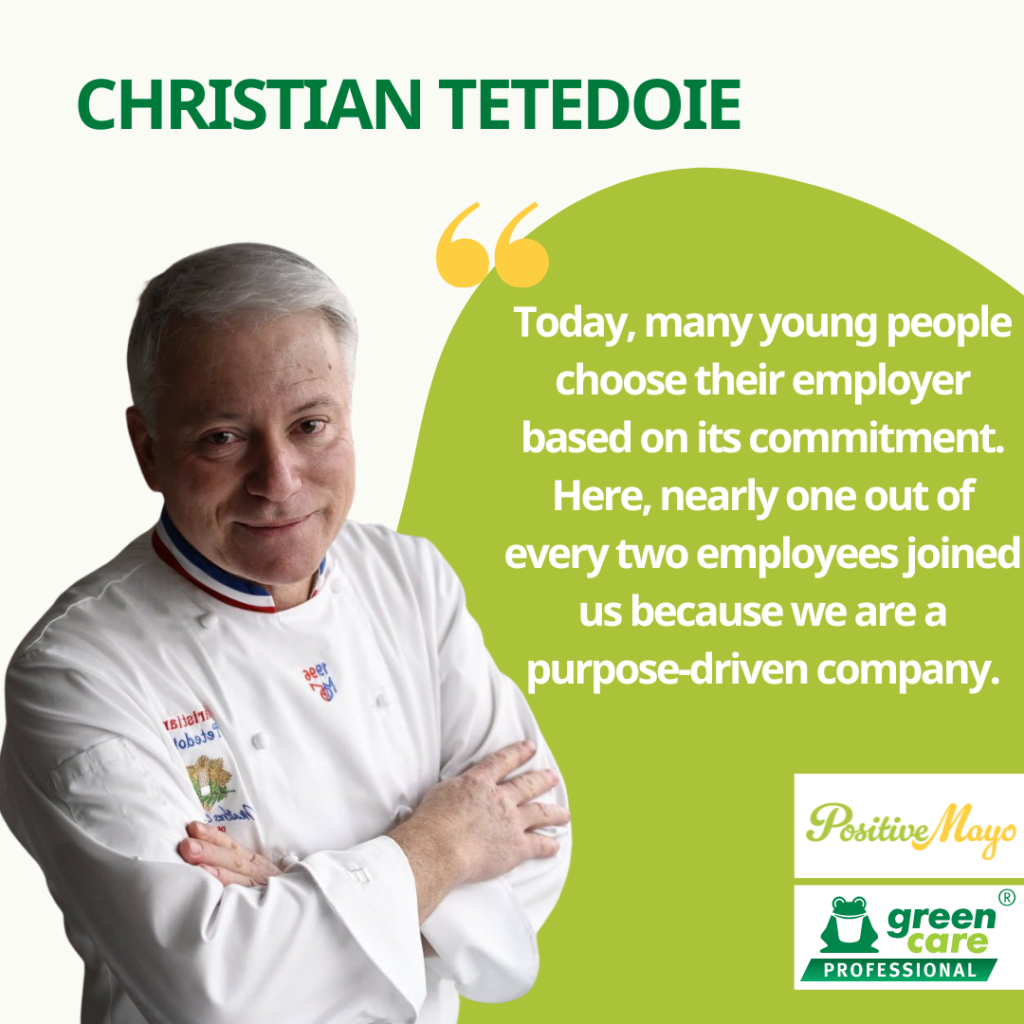
Oh, there’s no question about it. Today, many young people genuinely want to be part of this kind of approach, and they apply to companies that demonstrate a real commitment. I think it’s fair to say that around 50% of our employees chose to work here because we are a committed company.
Finally, what changes would you like to see in your sector when it comes to sustainability?
I know it’s not possible for every establishment, especially because some restaurants simply don’t have the space. But I do think it would be beneficial for restaurants to have a refrigerated area dedicated to organic waste.
There is still far too much waste in this area, even though this kind of facility is not actually that difficult to implement. I would really like my colleagues across the industry to pay more attention to this, so we can avoid sending tonnes of organic waste to incineration when it could instead be turned into compost and returned to nature—or even converted into biogas.