

What does responsible commitment mean to you?
My desire to get involved began with a chance encounter. At the end of a class I was teaching at École Ducasse, a participant came up to speak with me and mentioned his involvement with Les Restos du Cœur. It felt as though a whole new world had opened up to me.
I had always enjoyed sharing my passion for cooking — talking about it, teaching it — but I had never considered this kind of commitment. Everything in my life was going well, and I realized that I could easily dedicate two days a month to an association.
The welcome I received at Les Restos du Cœur was incredible. I expected to simply help distribute meals, but instead they offered me the opportunity to use my skills to support a wide range of people in reintegration programs — training them in a profession, teaching them how to cook.
Helping people facing serious hardship, with difficult life paths, find their way back into the workforce was truly meaningful.
And it’s something I have continued to do for the past three years. Beyond the satisfaction of working on textures, flavors, and techniques, the emotional reward is extraordinary.
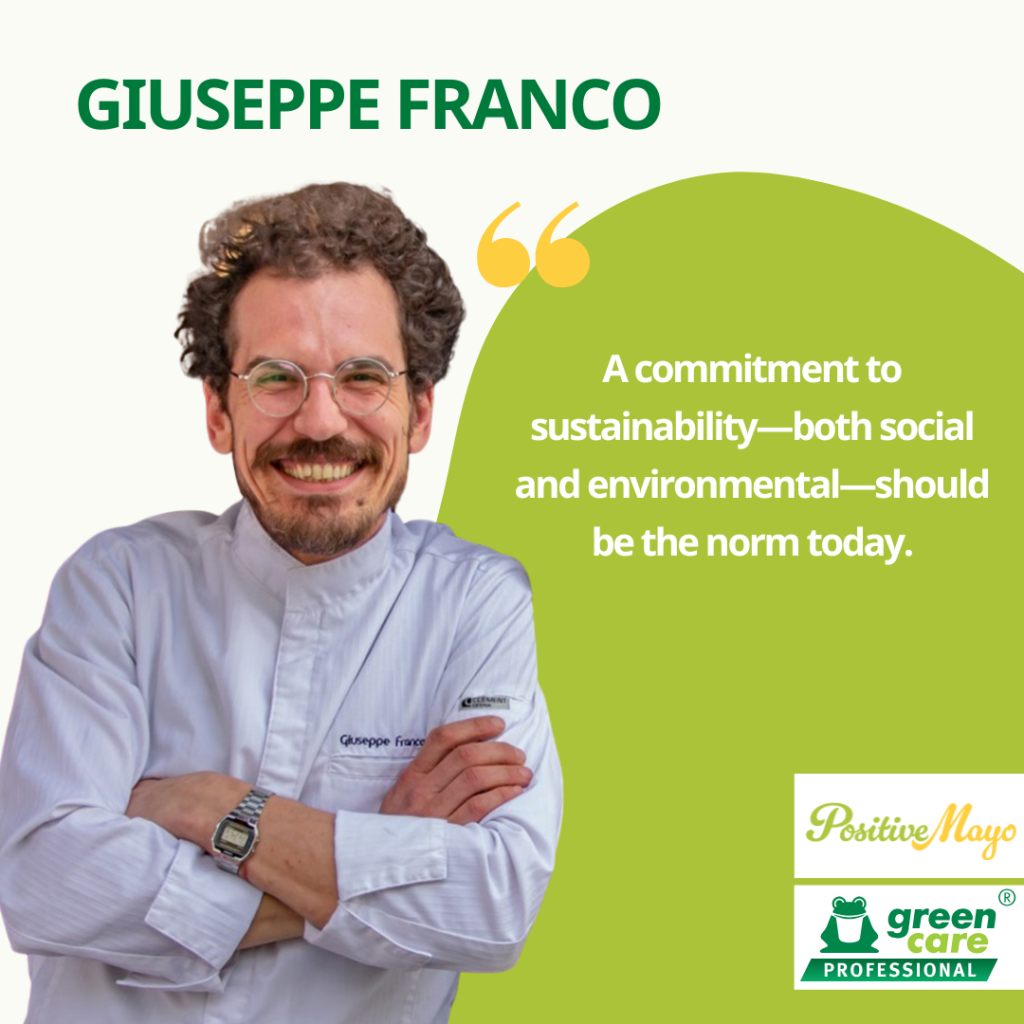
Today, commitment to sustainability should be a given. We can no longer turn away and pretend nothing is happening. Everything is right in front of us. In my home region of Puglia, rivers are disappearing, groundwater reserves are drying up, sea levels are rising… You would have to be blind not to see it.
In practical terms, what is your favorite eco-gesture or the most effective action you take on a daily basis?
On a daily basis, at École Ducasse, most of our commitment is focused on fighting food waste. We use everything!
Outside the school, this is also my philosophy — whether I’m working on private dinners, teaching cooking classes, or simply cooking at home.
How do you integrate this approach into your operational practices (hygiene, team management, environment, etc.)?
The important thing is to do as much as possible yourself, using raw and local ingredients. I avoid intermediaries as much as possible, only really buy seasonal products, avoid ingredients that come from far away, and eat less meat. That is the foundation, as it has a major impact on the environment.
And of course, no petrochemical products in my kitchen — whether for cooking or for cleaning and housekeeping. I only use eco-friendly products.
In your opinion, how can a sustainable approach enhance performance or create collective value?
A sustainable approach starts with respecting workers — that’s the foundation. People need to be given good working conditions, working side by side rather than in rigid hierarchies.
When people are treated well, teams naturally function better, with mutual respect. When they are under pressure, divisions appear, and those at the top end up putting stress on those below to achieve the same results.
When people feel good, they work well, stay engaged, and move forward together.
What changes would you like to see emerge in your sector in terms of sustainability?
We first need to stop importing so many products from elsewhere — vegetables, milk, and so on.
As Gualtiero Marchesi used to say: “It’s not the products that should travel, but the people who should travel to discover them.”
I also believe it’s interesting to work on culinary specialties using local ingredients. I like the idea of creating international dishes with local products.