
Gabriel, what does responsible commitment mean to you?
Commitment is first about taking care of yourself in order to take care of others.
It means working for the common good.
It means enhancing what we do and our relationships, adding value — such as kindness.
Through the art we practice — culinary art — we can bring all of this together to create something good, beautiful, and meaningful.
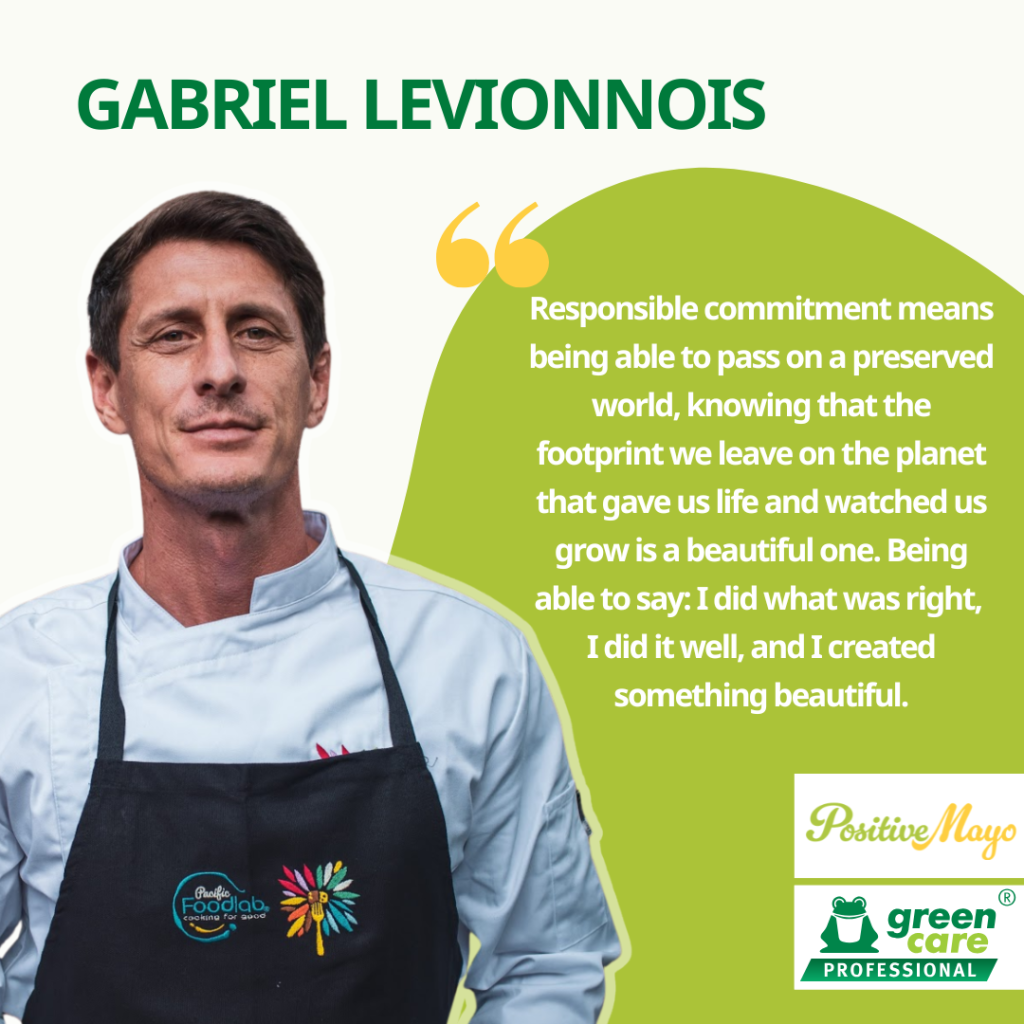
We can leave this world peacefully, knowing that the footprint we leave on the planet that saw us born and grow is a beautiful one — knowing that we have done good, good-tasting, and beautiful things.
In practical terms, what is your favorite eco-gesture or the most effective action you take on a daily basis?
My main eco-gesture is doing BETTER with leftovers — what I call “2.0 recipes.”
It’s not just about using leftovers, but about turning them into something even better than the original ingredients. Making things better. Making the future more desirable from an abundant past. When we’ve taken more than we need, we must now transform excess into something better.
Another eco-gesture: after having two children, I chose to have a vasectomy.
How do you integrate this approach into your operational practices (hygiene, team management, environment, etc.)?
I integrate my responsible approach into the cooking classes I teach. TRANSMISSION is essential. Explaining how things work, giving dignity to leftovers, strengthening culinary skills, learning how to cook with what we have.We must popularize this approach. Some chefs are still uncomfortable saying this. We must educate — even children — about this. We must value imperfect produce. A true chef must enhance them. There is no ugliness — only potential. My eco-gesture is making beautiful what does not initially shine.
I also SHARE on social media and YouTube.
We must dare to talk about eco-actions — otherwise they are lost. We must say we enjoy working with leftovers.
Yesterday, I had a whole group of children at home — mine and their friends — for dinner. I cooked sweet potato gnocchi for them, for example. They loved it, and I made sure to explain that it was made from leftovers. This is something we need to teach.
We must dare to value leftovers, as well as “imperfect” fruits and vegetables. A true chef should be able to elevate them. I like the image of Lady and the Tramp — I’m the tramp. In reality, there is no ugliness.
My eco-gesture is about making beautiful what may not seem impressive at first — about not overlooking what doesn’t shine.
In your opinion, how can a sustainable approach enhance performance or create collective value?
Yes — and we’ve made it a model. For example, in my restaurant Au P’tit Café. From the start, I thought SOCIAL. Everything comes down to leadership.
I decided that the team would work four days a week (four and a half today). The restaurant industry is a demanding one, so it’s essential to ensure that employees are treated well. We’ve been doing this for 18 years, and we perform very well. The restaurant is highly rated, financially stable, we pay our suppliers, and we retain our teams over the long term. We work less, but better.
The sustainability of an organization lies in its ability to lead — that’s what drives the restaurant’s performance.
I believe in participative leadership. For example, the menu is co-created. This co-creation is effective: teams stay, suppliers are paid, and customers are satisfied.
The art of building a sustainable way of cooking lies in training chefs in participative leadership — doing together what cannot be done alone. Developing the ability to synchronize all elements so that everything works smoothly.In Tahitian, there is an expression: nave nave, which means gentle and delicious. We should build nave nave organizations — for the good of all.
What changes would you like to see emerge in your sector in terms of sustainability?
We’ve learned how to read and write, but we haven’t learned how to eat in today’s world. Modern food culture has come with abundance, but without instructions.
There will be no ecological transition without a food transition — and if we don’t begin it, we risk compromising life on Earth.
What we need is no longer a transition, but a metamorphosis. We are going to transform our food culture into something we don’t yet fully know.